UX Case Study
St. Jude
Hope
Hope was the first AI chatbot created for St. Jude Children's Research Hospital, built on Salesforce Einstein to support donors, patients, and families 24/7 while maintaining the warmth and clarity the St. Jude brand is known for.
Overview
Project Overview
The Problem
St. Jude's live agents were only available during business hours, and the existing FAQ page was hard to navigate, leaving donors, patients, and families without real support outside those windows. Hope needed to handle routine inquiries confidently, escalate gracefully to a human when needed, and feel warm rather than transactional throughout.
Business Goals
User Goals
My Role
I led the conversational design end-to-end, defining Hope's tone, mapping every intent, and writing the dialog flows across all user scenarios. The utterance library I built to train Hope's NLU model grew to 42,318 training phrases. Hope's launch also established the internal framework St. Jude used for all future Einstein bot deployments.
Research
Understanding the Landscape
Why St. Jude Needed Hope
Agents Were Overwhelmed
Live chat and call center teams were fielding a high volume of routine inquiries (donation questions, account updates, general info), leaving little bandwidth for complex cases that truly needed a human.
No 24/7 Coverage
Live agents were only available during business hours. Donors and families visiting at night or on weekends had no way to get quick answers, a missed opportunity for an organization always trying to be there for families.
FAQ Pages Weren't Working
The existing FAQ page was hard to navigate. Users had to scan through long lists to find answers. They needed a guided conversation, not a wall of links, especially given the emotional context of many St. Jude visits.
Who Was Using Hope?
St. Jude is the third-largest health-related charity in the US, with a national donor base spanning varied demographics. Three distinct user groups would interact with Hope.
Donors
Emotionally invested supporters, often motivated by a personal connection to childhood cancer or a desire to give back. They want to donate easily, manage a recurring gift, or understand their impact, without friction.
Patients & Families
Families navigating a stressful, life-changing situation. They have questions about covered services, travel support, and what costs St. Jude handles. They need clarity and warmth above all.
General Visitors
Curious supporters, volunteers, event participants, or first-time visitors. They may want to explore fundraising ideas, learn about the mission, or find ways to get involved.
Emotional Stakes
Users reaching out to St. Jude are often in vulnerable moments: parents of patients, grieving donors, people navigating complex medical situations. The chatbot couldn't feel cold or transactional.
HIPAA Compliance
Salesforce Einstein's In-App and Web chatbots meet HIPAA requirements, enabling secure handling of sensitive donor and patient-adjacent conversations without exposing PHI.
NLU Over Script
Rather than a rigid decision tree, Einstein uses Natural Language Understanding, so Hope needed to be trained to recognize how real people phrase questions, not just exact keywords.
Human Escalation
No chatbot should be a dead end. The escalation path to a live agent had to be frictionless, clearly communicated, and never feel like a failure state for the user.
Defining the MVP Scope
Working closely with the call center team, we audited the live agent logs to surface the most-asked questions. From that list, we defined the focused topic set Hope would handle at launch.
FAQ Source Analysis
The St. Jude FAQ page and live agent logs were audited to identify the highest-volume recurring inquiries. These became Hope's MVP intent list.
How to Make a Chatbot Not Sound Robotic
Use natural, conversational language
Set clear expectations early in the interaction
Guide with simple, focused prompts
Make it easy to connect to a live agent
Be transparent when an answer can't be found
Design
Creating Hope
Conversation Flow Architecture
All 34 Intents Built for Hope
Voice & Tone: Designing Hope's Personality
Hope's voice needed to feel like a real person, warm, direct, and never robotic. The goal was to reflect St. Jude's mission of compassion in every single message: guiding users clearly so they never felt confused, and always making sure help was one tap away.
Every response was written to provide direction, not just information. Rather than dumping an answer and leaving the user adrift, Hope always offered structured options so the path forward was obvious.
What We Learned at Launch
Real users surfaced behavior we hadn't fully anticipated. Two findings shaped the final experience.
Users Were Writing Paragraphs
At launch we hadn't told users how to talk to Hope. They typed long, complex questions, sentences with multiple requests, which the NLU model struggled to parse. Intent confidence dropped and responses became unreliable.
Fix:
One line added to the opening greeting. Immediately improved NLU accuracy as users adapted their input to match Hope's strengths.
The Fallback Had to Feel Human
A generic error message frustrated users and made them feel trapped in a chatbot loop, especially damaging for an organization built on compassion. The fallback needed to be warm, honest, and immediately actionable.
Hope's confused message:
The escalation never felt like a failure. It felt like a warm hand-off.
Hope's Responses in Practice
Testing Before Launch
Before going live, Hope's dialogue flows were tested internally with teammates acting as users across each intent category. We stress-tested edge cases: misspellings, out-of-scope requests, and emotionally charged language, to ensure Hope always responded with clarity and warmth.
Salesforce Einstein
Putting Hope into Einstein
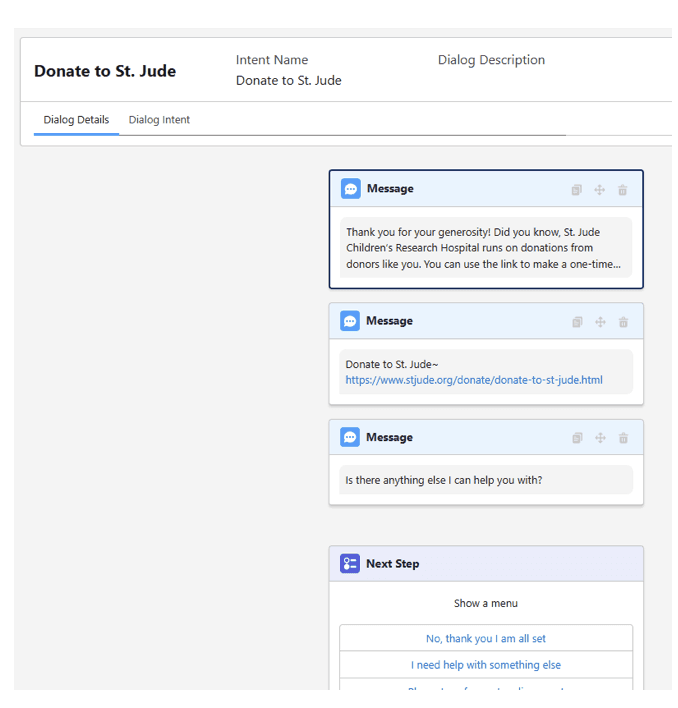
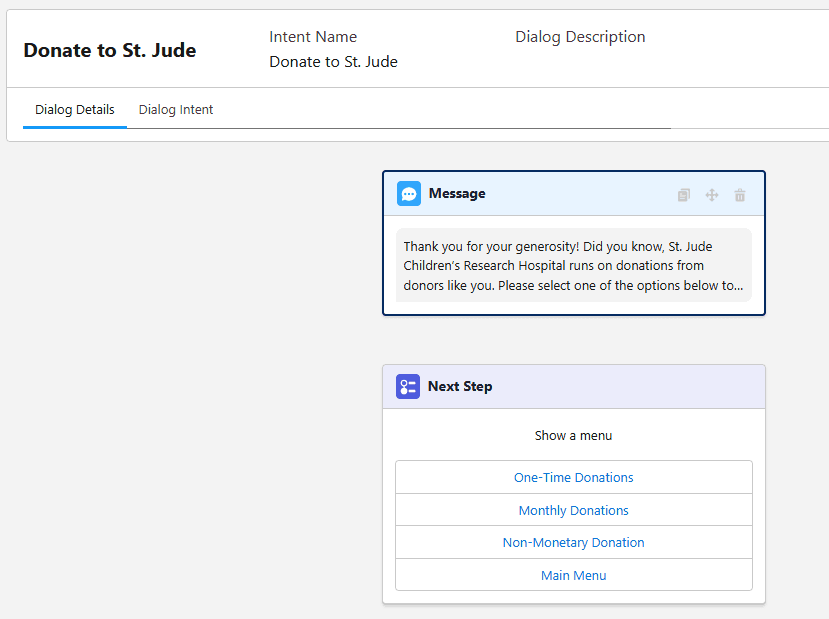
Salesforce Einstein served as the platform that hosted Hope. Each conversational response was built as a named Dialog in the Einstein Bot Builder, pairing an Intent Name with dialog details that defined the exact message and decision tree Hope would follow.
Intent Name
A unique label mapping to one user need (e.g. 'Donate to St. Jude')
Dialog Details
The message Hope sends, plus structured menu options (One-Time, Monthly, Non-Monetary, Main Menu)
Dialog Intent
The utterances that trigger this dialog: the raw phrases users might type
Escalation Logic
A 'Please transfer me to a live agent' option surfaced at every resolution point
Generating Utterances
Utterances are the phrases that teach Einstein's NLU model to recognize user intent, not just exact keywords, but the many natural ways a real person might express the same need. Each Intent required a minimum of 20 unique utterances to activate training, but more always improves accuracy.
For each dialog I'd written, we generated utterances covering the full range of ways a donor, patient, or family member might phrase that request, keeping them close to natural language, varied in length, and free of proper nouns so the model could generalize cleanly.
After uploading, the NLU model was rebuilt in Einstein's Model Manager off-peak to avoid downtime. We reviewed the NLU dashboard after each rebuild to catch intent confusion before it reached real users.
More utterances = better NLU accuracy. The goal was for Hope to recognize natural language variations: "How do I give money?" and "I'd like to make a donation" should both trigger the same response.
EXAMPLE: "Donate" Intent Utterances
Hope Live on St. Jude
Contact Us, Elevated
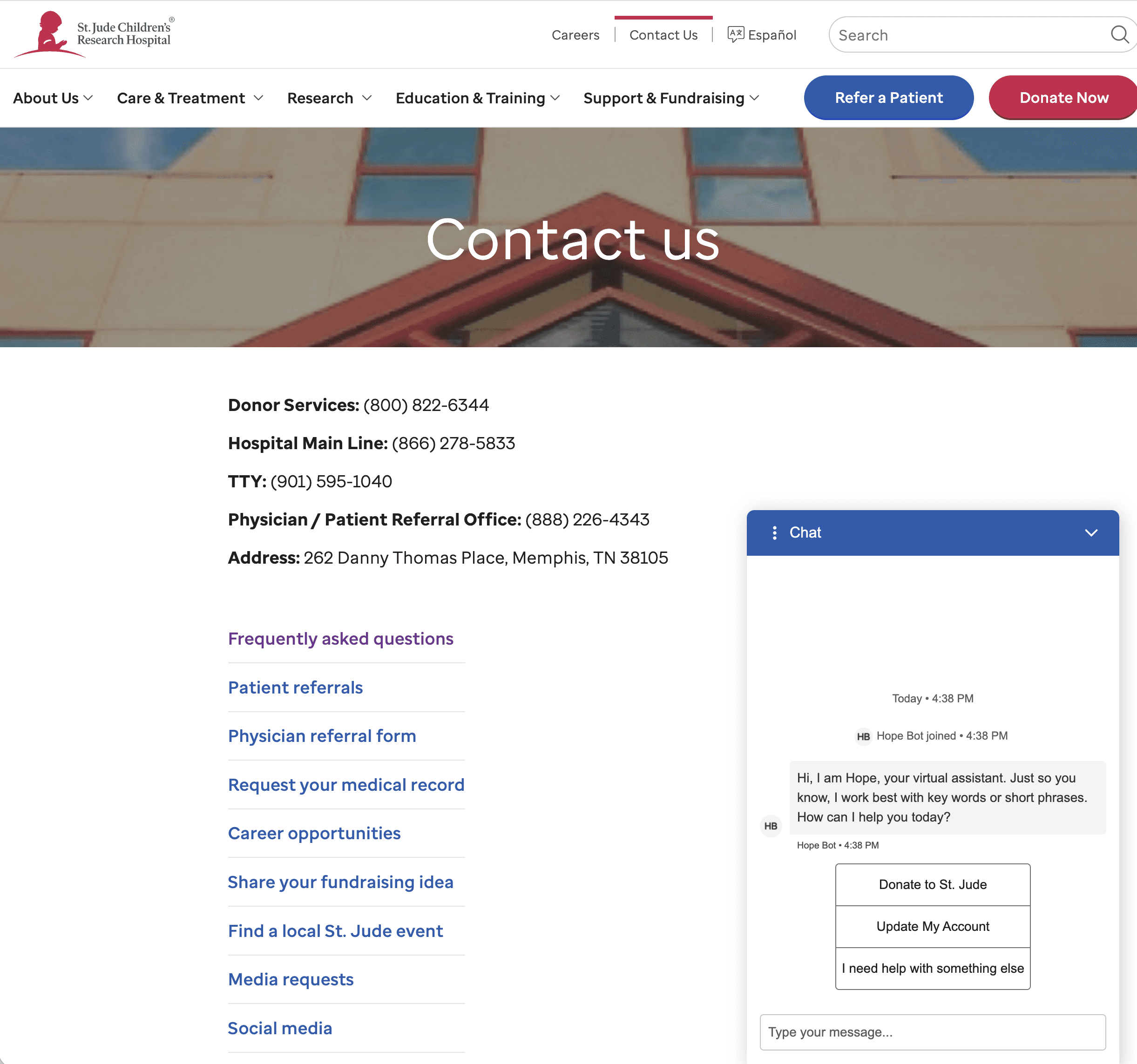
Hope launched on the St. Jude contact page, the highest-traffic entry point for users seeking support. Embedded via Salesforce's Embedded Chat deployment, Hope appears as a persistent widget available 24/7, even when all live agents are offline.
Outcomes
What We Delivered
Hope launched on the St. Jude contact page and immediately began deflecting routine inquiries from the call center, giving live agents more time for high-complexity conversations while giving users immediate answers, around the clock.
Impact Summary
Next Steps
What's Next for Hope
Key Takeaway
"The most powerful design decision wasn't what Hope said. It was knowing when to hand off to a human."
For an organization whose entire identity is built on human compassion, a chatbot that knew its limits and made escalation feel natural, not like a failure, was the real product. Hope wasn't a replacement for St. Jude's people. She was the bridge to them.
Expand Hope's intent library to cover patient referral inquiries and volunteer sign-up flows, reducing calls to those specific lines.
Implement multi-language support (Spanish first, given St. Jude's bilingual resources) to serve a broader donor and family base.
Introduce sentiment detection: if Hope identifies distress signals in a user's messages, escalate immediately to a live agent without requiring the user to ask.
Build post-conversation analytics dashboards to measure resolution rate, escalation rate, and intent coverage gaps for ongoing optimization.
Explore proactive chat triggers, deploying Hope contextually based on the page the user is visiting (e.g. prompting donation help on the Give page).
Interactive Prototype
Try Hope Yourself
This is a working model of Hope, wired with the real intents and responses from the live St. Jude bot. Type a question the way a donor would, or tap a quick reply, and Hope matches it to an intent and answers, just like the production assistant.